Film 02 · Mereotopology
Which boundary counts?
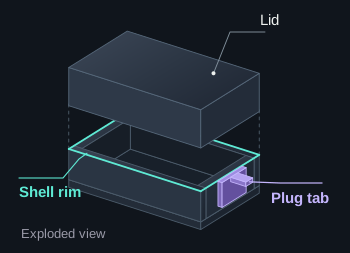
If you’re checking whether a lid sits flush, you put the calipers where the lid meets the housing. The grip tab sticking out of a service plug has nothing to do with that measurement. But if you’re checking whether the cavity is closed to the outside, that same plug matters. Pull it back two millimetres and a passage opens behind it, even as the lid stays perfectly flush.
The grounding question
Give Impulse the instruction “Keep this cavity closed” while the housing still has a solid wall. Later, the agent cuts a service opening and fits a plug. Who tells it that the instruction now applies to the plug?
In 2023, researchers studying robotic battery replacement gave a program a description of the battery and its holder. The program could reason about which parts should touch. The authors left finding those contact points on the actual CAD model for future work. [1] Two years later, researchers studying 3D-printed parts described how they identified the features in their analysis: “Currently, features and primitives are recognised manually.” [2]
How Hylos resolves it
We built Hylos so an engineer can give Impulse a requirement before the parts that satisfy it have been drawn. Impulse uses the geometry of the opening, how the parts were made, and how they fit together to work out that the plug’s face now closes the cavity. If the next edit leaves a gap, the agent can trace the route outside and reject the edit.
The engineer never had to come back and select the plug.
Where the seven millimetres come from
Look down on the housing and trace its outline just below the lid. Your pencil runs along the shell, out to the tip of the grip tab, and back. Now trace the lid just above the seam. At the tip of the extended tab, the two outlines are 7 mm apart.
That’s a real measurement. For each point on either outline, find the nearest point on the other and take the largest of those distances. It’s called the Hausdorff distance. Apply it to the two shell rims and you get 0 mm. Apply it to the whole outlines and you get 7 mm. You could send a good lid back for machining if you took the second reading as evidence of a bad fit.
Watch the two rims line up at 0:27 →
Fig. 1 · The seam & caliper selector
Choose the edges to measure
The service plug belongs to the assembly. Its grip tab sticks out past the seam.
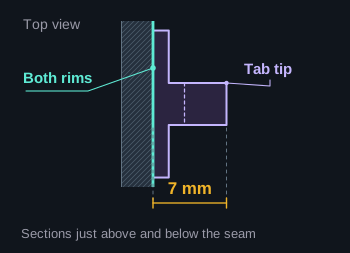
7 mm Hausdorff distance. One jaw lands on the lid edge; the other lands on the plug tab.
- Engineer specified
- “Keep the two shell rims flush.”
- Impulse determined
- The shell edges coincide. The 7 mm projection belongs to the plug tab. Rim mismatch is 0 mm.
What opens when the plug moves
The plug has a narrow stem and a broad face. There’s a little room beside the stem even when the plug is seated. Follow that gap from inside the housing and you run into the back of the plug’s face. Pull the plug out 2 mm and you can get around the face and reach the outside.
Fig. 2 · Through the service opening (z = −5 mm section)
Cavity connectivity across the plug flange
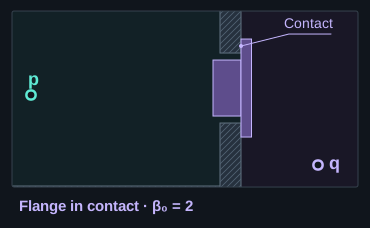
There is room beside the stem, but the broad face of the plug closes the way out.
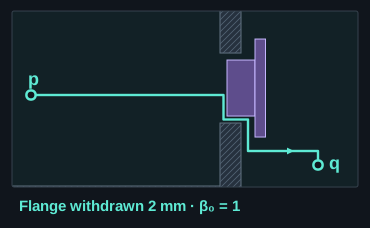
Follow the path around the stem and behind the flange. It reaches the exterior without crossing solid material.
- Engineer specified
- “Keep the cavity isolated from the outside.”
- Impulse determined
- The seated plug blocks the route. Pull it out 2 mm and a continuous path joins p inside to q outside.
That distinction is where mereotopology, the study of parts and how they connect, becomes practical. For the fit check, Impulse follows the construction of each shell to find its rim. For isolation, it considers all the material that could block a route out, including the plug. Connecting the engineer’s words to the right geometry on this revision is the work of semantic grounding.
| Change to the housing | Rim mismatch | Route to the outside |
|---|---|---|
| Extend the grip tab from 3 to 7 mm | 0 mm | Closed |
| Shift the lid sideways by 1 mm | 1 mm | Closed |
| Pull the plug outward by 2 mm | 0 mm | Open |
Each row starts from the same closed housing. If the lid shifts, Impulse can point to the misaligned rims. If the plug moves, it can trace the new passage and reject that edit under the original isolation requirement.
What the path proves
Mark a point p inside the cavity and a point q outside. One continuous path through empty space from p to q is enough to show the cavity is open. To establish that it’s closed, Impulse checks the full three-dimensional geometry. A single drawing could miss a passage above or below the cut.
With the plug seated, the empty space has two connected pieces. Pull the plug back and they become one. In homology, that count is β0. At 1:11 the film unfolds the escape path into three pieces. At each bend, arriving along one piece cancels leaving along the next. Only the endpoints survive, so the boundary of the whole path is ∂c = q − p. That’s why these two particular points now represent the same class in H0. The film then shows the same cavity from the material side through Alexander duality. [3]
Follow the path proof at 1:11 / 1:52 →
The result is geometric and assumes perfect contact where the faces meet. A pressure rating would also require evidence about tolerances, materials and leakage under load.
The boundary of the escape path
Mark the two bends u and v. Each is an endpoint of one segment and the starting point of the next.
For the empty space V, the two components contribute one copy of ℤ each to H0(V) while the plug is seated. Opening the path leaves one. In the compactified exterior, Alexander duality pairs the lost reduced homology class with a degree-two cohomology class of the solid.
Research cited
- F. Leoty, J. Thai, B. Archimède, P. Fillatreau and M. Grüninger (2023). Using Mereotopology for Automated Spatial Inference in Task and Motion Planning, §§3.2–4.
- C. Douin, E. Gruhier, R. Kromer, N. Perry and O. Christmann (2025). Part description to enhance interaction between design and additive manufacturing based on spatio-temporal mereotopological theory, §6.
- A. Hatcher. Algebraic Topology, Proposition 2.7 and Corollary 3.45.
Read the timed transcript
- Keep this cavity closed.
- Impulse cuts a service opening.
- The new plug’s sealing face now closes it.
- The engineer gave that instruction before this plug existed.
- Impulse found the sealing face itself.
- Trace the outlines on either side of the seam. The tab sticks out three millimetres.
- Make the tab longer. The reading grows to seven millimetres. The shell rims are still flush.
- Follow each shell’s construction record to the rim named by the alignment check. Keep the plug in view.
- Superimpose those two rim curves. Every point finds a matching point. Their Hausdorff distance is zero.
- Retract the tab. Both rim curves hold their positions while the silhouette moves.
- Mereotopology studies how parts connect to form a whole. Is there a path out?
- The installed plug belongs to the occupied material. Its sealing face separates the cavity from the exterior.
- There are two path components. Each contributes one generator to H₀.
- Lift the sealing face. The clearance around the stem now connects to a gap under the flange.
- Follow a computed path from p to q. The drawing is a section. The component count uses the full three-dimensional fixture.
- Unfold that path into three oriented pieces. Read each boundary as the endpoint minus the starting point.
- The interior vertices cancel in pairs. The boundary of the whole chain is q − p.
- That is why p and q represent the same class in H₀. With the plug seated, they represented different classes.
- The sealed cavity is one extra component. Its difference from the exterior generates reduced H₀.
- Read the same cavity from the material side. Alexander duality pairs it with a degree-two cohomology class.
- Test the two measurements. Grow the tab. The rims still coincide and the two void components persist.
- Shift the upper shell by one millimetre. A seam step appears while overlapping wall material keeps the cavity enclosed.
- Return the shell and lift the plug. The rim distance stays at zero while the two void components join.
- Seat the plug again. Each question has its own geometric witness.