Film 01 · Control theory
The Lyapunov descent clock
The sliding valve needs a sealing surface at least 10.5 mm long. Its housing has room for 10.0 mm. If the only thing an engineering agent can change is the length of that surface, you can give it as many retries as you like. Every length will fail one of the two requirements.
The half-millimetre conflict
The band of metal that covers the opening is called the land. Centre a 10 mm land over a 6 mm opening and you have 2 mm of cover on each side. At the end of the valve’s stroke, the land has moved 2 mm. On one side, its edge now lines up exactly with the edge of the opening. The drawing calls for another 0.25 mm of cover there.
Try the longer land. At 10.5 mm, it gives you 0.25 mm of cover on the short side at full stroke. The seal check passes. The size check fails. Impulse rolls back the edit, and the gap is back.
Look at the valve before and after that attempt. Everything is where it started. What would stop the agent from doing exactly the same thing again?
Why the camera tilts
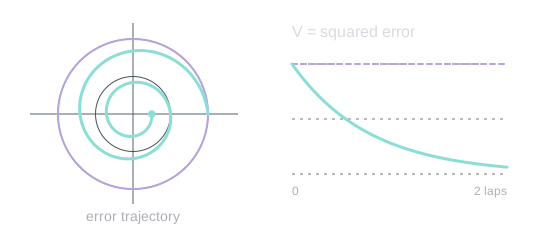
Picture a dot moving around a target. After a full circle, it’s exactly as far from the centre as when it started. Give it a little inward motion and the next lap crosses closer in. You can measure the difference. If the radius halves, the squared distance to the target falls to a quarter of its previous value. That squared distance, V = e₁² + e₂², is the Lyapunov function in the first two graphs. [1]
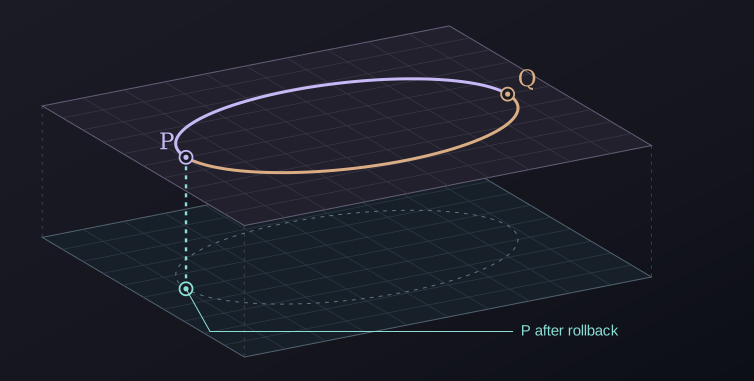
Now watch the valve at 0:51. From above, the failed edit and the rollback make a closed loop. The camera tilts. The point marking the restored valve sits directly below its starting position. Before the attempt, the supervisor allowed two retries. Now it allows one. The drawing came back. The spent retry didn’t.
 Supervisor state Jump to 0:51 / 1:37
The valve is back at P. Its supervisor has charged one retry.
If the engineer has allowed changes to both parts, Impulse can lengthen the original 8.0 mm land to 10.0 mm, then narrow the opening from 6.0 to 5.5 mm. Run the valve back to full stroke. There’s the missing quarter millimetre on the short side, and this time the part fits.
Watch both edits and the full-stroke test at 1:06 →
Interactive inspection · Full stroke (+2.0 mm offset)
Width of the housing opening
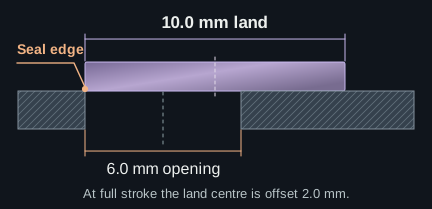
0.00 mm cover. The 10.0 mm land fits the housing envelope but falls 0.25 mm short of the seal requirement at full stroke.
| What just happened | Open requirements | Retries left | Repair stage, counted down |
|---|---|---|---|
| Start | 1 | 2 | 2 |
| Roll back the failed edit | 1 | 1 | 2 |
| Reopen both parts for repair | 1 | 1 | 1 |
| Verify and accept the repair | 0 | 0 | 0 |
Read each row from the left. The first number that differs tells you how the state advanced. On the rollback, it’s the retry count. On the next turn, it’s the move from adjusting one part to reopening both. Once the valve passes both checks, the film returns to the tilted loop. The point moves to R, where Impulse commits the repair and the open requirement count drops from one to zero.
Replay the move to the verified state at R →
Robot planners encounter a similar problem when an earlier placement makes a later move impossible. In 2023, Sung, Wang and Stone showed how a planner could learn which earlier action to revisit. In physical design, that earlier choice may already be part of a drawing the agent has accepted. Here, it was the width of the opening. [2]
When the engineer needs to step back in
There are two decisions here. One is whether the agent has earned another attempt. The other is whether the finished part passes. Jason Liu’s 2026 preprint addresses what evidence a tool-using agent must produce before declaring a task complete. An engineering team also needs a way to govern the attempts leading up to that declaration. [3]
Suppose the customer specified the 6.0 mm opening and the housing limit is fixed too. Impulse can bring the engineer an exact conflict. Keeping the opening requires room for a 10.5 mm land. Keeping the housing limit requires a narrower opening. The engineer can decide which requirement to revisit without supervising another round of failed edits.
The stopping argument
The film uses three numbers to make the rollback easy to see. The formal argument accounts separately for unfinished parts, open blockers, physical error in measured bands, and the allowance for repeated attempts. For a fixed brief, if each evaluation returns and every continuing turn strictly lowers that ordered rank, the run must end. A tuple of natural numbers can’t descend forever in lexicographic order. The valve’s measured fit and seal margin determine whether that ending is an accepted design. [4]
Research cited
- R. Tedrake. Lyapunov Analysis, Underactuated Robotics, MIT.
- Y. Sung, Z. Wang and P. Stone (2023). Learning to Correct Mistakes: Backjumping in Long-Horizon Task and Motion Planning.
- J. Liu (2026), preprint. When May an Agent Stop? Evidence-Carrying Termination for Tool-Using LLMs.
- A. R. Bradley, Z. Manna and H. B. Sipma (2005). Linear Ranking with Reachability.
Read the timed transcript
- Imagine two design errors. At the centre, both are zero. Follow the point for one lap.
- It lands back on its starting mark, still one radius from the target.
- The velocity is tangent to the radius. The squared distance stays level on the right.
- Keep the rotation. Add a small velocity pointing inward.
- Watch the point cross the same ray. This time it crosses closer to the centre.
- Halve the radius on each lap and the squared error falls to a quarter of its previous value.
- This is continuous descent. The spiral approaches its equilibrium as time passes.
- Now let the point represent a design. At P, the valve exposes a gap at full stroke.
- The agent lengthens the land. The seal passes, but the proposed part exceeds its envelope.
- Roll back the draft and the old gap is back. A free retry could trace this same loop again.
- Tilt the picture. Geometry was only the view from above. The supervisor also records a rank.
- The solid returns to P. Charging the retry lowers the middle coordinate from two to one.
- Opening both handles advances the stage. The third coordinate drops while the first two tie.
- Look at the seal now. Lengthen the land from 8 to 10 mm, the most the housing allows.
- The edges just meet. Narrow the port from 6 to 5.5 mm, keeping its centre fixed.
- Return the valve to centre and run it to full stroke again. Watch the short edge.
- At full stroke there is 0.25 mm of cover on the short side. The 10 mm land fits.
- The repair clears the last open requirement. Impulse commits it at R.
- A closed chain of credited turns would require a rank to be smaller than itself.
- Natural-number ranks also rule out endless descent. An exhausted run can end with an engineering decision.